NCDOT's Carolina Beach Rd. Widening Project Claims First Hospitality Casualty
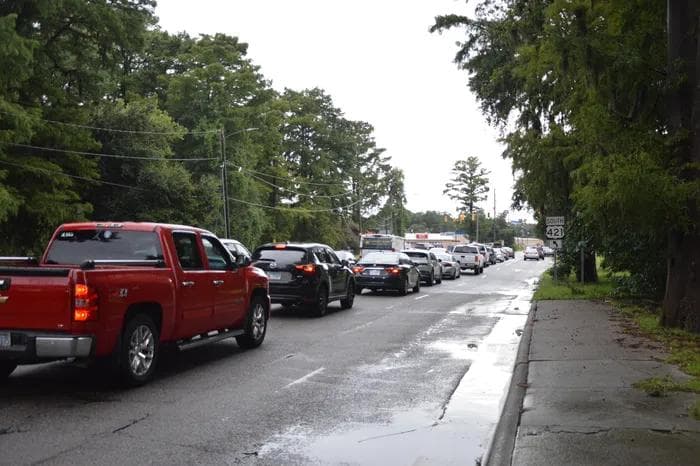
NCDOT's Carolina Beach Road widening forces Greenfield Yacht Club bar closure — what it signals for corridor owners and investors in Wilmington.

Apr 28 2026
1 min read
Business Summary
NCDOT's Carolina Beach Road widening project has forced the permanent closure of Greenfield Lake Yacht Club bar at 1756 Carolina Beach Rd. in Wilmington. The bar's April 2026 shutdown is the most visible commercial displacement to date on a corridor already being reshaped by infrastructure spending and new retail entries. For investors and landlords holding parcels along this stretch, the project is simultaneously a liquidity event and a source of prolonged uncertainty.
Note: The original research cites projected costs of $35.8 million (ROW), $3.2 million (utilities), and $37.5 million (construction), totaling $76.5 million. However, verification searches found widely varying figures across NCDOT documents — including $4.775 million for ROW acquisitions in one source and phased construction estimates ranging from $9 million to $45 million per segment. The $76.5 million combined figure from Port City Daily could not be independently confirmed against official NCDOT budget documents and should be treated as one reported estimate, not a verified total.
Fast Facts
- Property address: 1756 Carolina Beach Rd., Wilmington, NC
- Property purchase price: $450,000 (landlord Al Cervini, acquired 2023)
- Business acquired: 2022 by Billy Mellon, Fred Flynn, and Audrey Holloman
- Final day of operations: April 26, 2026
- Reported projected ROW acquisition cost (project-wide): $35.8 million (per Port City Daily; NCDOT documents show varying figures)
- Reported utility relocation cost: $3.2 million (per Port City Daily)
- Reported construction cost: $37.5 million (per Port City Daily; NCDOT documents show varying figures by segment)
- ROW acquisition phase: Began late 2025
- Construction bids expected: Summer 2029
- Parcels affected: At least 12, up from 7 in 2019 designs
- Other displaced businesses: Han Dee Hugo's gas station, JT Lea and Son's propane distribution
What Happened
NCDOT approached the Yacht Club site approximately one year ago — around early 2025 — as part of the right-of-way acquisition phase for the Carolina Beach Road widening. The project targets the elimination of left turns at the corridor's main intersection to improve traffic flow. Negotiations between NCDOT and landlord Al Cervini are ongoing; no closing has been finalized. NCDOT follows a fair-market-value compensation policy, with relocation costs addressed on a case-by-case basis. Specific compensation terms remain private.
The bar's ownership group — Mellon, Flynn, and Holloman — purchased the business (formerly The Dubliner) from Andrew Brothers in 2022. Cervini bought the building and land separately in 2023 for $450,000. After years of uncertainty dating back to 2019 project planning, the owners confirmed a permanent closure. Owner Mellon decided to shut down rather than renew a $2,000 liquor license expiring at the end of April 2026, as the property must be vacated by fall 2026. "State owned property, no trespassing" signs were already posted on adjacent parcels. The bar hosted a farewell event on April 26, 2026. The owners are actively seeking a new site near Greenfield Lake to retain the brand.
Why It Matters
This closure converts an abstract infrastructure timeline into a concrete displacement event. It signals that NCDOT's ROW phase is now actively consuming commercial parcels — and that owners along the corridor face a narrowing window for negotiation, relocation, or exit.
The reported $35.8 million ROW budget across 12+ parcels implies significant per-parcel acquisition costs, though individual amounts are undisclosed. For Cervini, the $450,000 purchase price in 2023 sets a rough floor for what fair-market-value negotiations might reference, but actual compensation will reflect current appraisal, improvements, and relocation factors. The gap between acquisition in 2023 and forced sale in 2025–2026 creates an unusually short hold period with compressed return potential.
For the broader corridor, the project is reshaping the competitive landscape. Sheetz opened its third Wilmington-area location at 6401 Carolina Beach Road on May 1, 2025, across from Veterans Park and Ashley High School, with another site planned approximately three miles south. National chain investment suggests commercial interest is not retreating — it is repositioning around the infrastructure upgrade.
What Stands Out
- Timeline drag creates business risk: Planning began in 2019, ROW acquisition started in late 2025, and construction bids won't go out until summer 2029. That is a 10-year horizon from design to build — a punishing uncertainty window for small operators and landlords.
- Parcel count nearly doubled: The affected footprint expanded from 7 parcels in the 2019 design to at least 12 today. Additional acquisitions may still emerge as engineering is finalized.
- Hospitality is structurally disadvantaged: Gas stations and propane distributors can relocate equipment. A bar built on location identity and neighborhood foot traffic cannot easily replicate its customer base — especially when seeking to stay near Greenfield Lake where available commercial parcels are limited.
- Short ownership cycles amplify loss: Both the business (acquired 2022) and the building (acquired 2023) changed hands recently. Neither owner had time to fully capitalize on the asset before displacement.
- No public data on relocation outcomes: NCDOT's case-by-case policy keeps compensation private, which limits the ability of other corridor owners to benchmark expectations.
Market Lens
Angle: Corridor Strength
Carolina Beach Road is Wilmington's primary artery to the southern beaches — a high-traffic, high-visibility corridor that has historically attracted convenience retail, auto services, and neighborhood hospitality. The widening project is a major infrastructure investment reshaping this corridor. The arrival of Sheetz — now with three Wilmington-area locations and a fourth planned — signals that national chains see post-construction upside in traffic volume and access improvements.
For remaining parcel owners, the calculus splits two ways. Those inside the ROW footprint face compulsory acquisition at fair market value — a liquidity event, but not necessarily on favorable terms or timing. Those outside the footprint may benefit from improved road capacity and visibility, but face 3+ years of construction disruption before any upside materializes. Lenders underwriting properties along this stretch should stress-test for both scenarios.
The displacement of a hospitality venue in favor of road infrastructure also reflects a recurring tension in Wilmington's growth pattern: transportation investment tends to favor throughput over placemaking, and independent operators bear disproportionate transition costs.
Risks & Watch-Outs
- Execution timeline: A summer 2029 bid target means construction could stretch into 2031–2032. Delays in ROW closings or utility relocation could push that further.
- Compensation uncertainty: Private negotiations mean no public benchmarks exist for affected owners to gauge whether offers are competitive. Owners without experienced condemnation counsel may leave value on the table.
- Relocation viability: The ownership group's search for a new Greenfield Lake site is unresolved. Limited available commercial inventory near the lake makes a seamless brand transfer unlikely.
- Corridor disruption: Multi-year construction will suppress traffic counts and visibility for surviving businesses, compressing revenues during the build-out phase.
- Expanding footprint risk: The jump from 7 to 12+ parcels suggests the project scope could widen further, putting additional properties in play.
Bottom line for decision-makers: The Yacht Club closure is the first tangible displacement from a corridor project that will reshape Carolina Beach Road's commercial fabric through at least 2030. Owners and investors holding parcels along this stretch need to assess ROW exposure now — not when NCDOT knocks. For those outside the footprint, the post-construction corridor may offer improved fundamentals, but the path there runs through years of disruption and compressed near-term returns.

Jordan Reese
Jordan Reese covers commercial real estate and business trends across Wilmington and the greater Cape Fear region. With a focus on investment activity and regional growth, Jordan provides clear, research-informed reporting for business owners, investors, and civic stakeholders.
Related Posts
More stories from the same category

Recent Posts
Stay up to date with our latest stories






Subscribe to Newsletter
Provide your email to get email notification when we launch new products or publish new articles