Sweet n Savory's $900K Tax Debt Exposes Fragility of Wilmington Independents
Sweet n Savory's $900K tax debt and 33% demand shortfall expose structural risks facing Wilmington's independent restaurant operators.

Apr 27 2026
1 min read
Business Summary
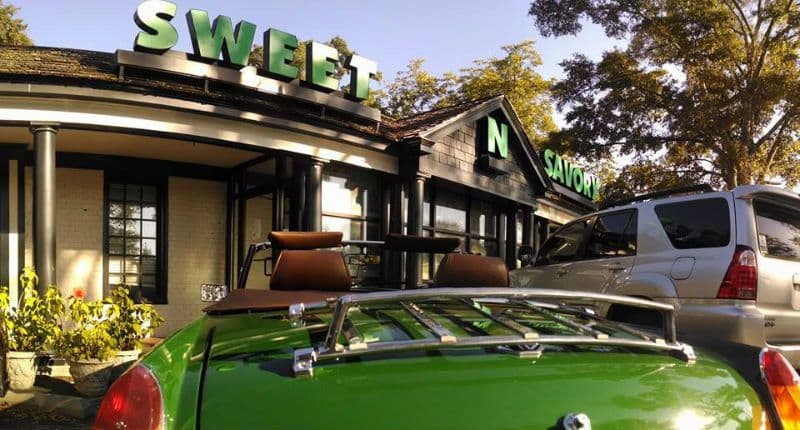
Sweet n Savory Cafe, a long-running Wrightsville Beach-area institution operating for more than two decades, permanently closed on February 6, 2025, after a federal bankruptcy judge converted its Chapter 11 reorganization to Chapter 7 liquidation — citing gross mismanagement, unauthorized use of cash collateral, and failure to reserve payroll and sales taxes. The closure, paired with the recent shutdown of Pinpoint Restaurant after a decade downtown, removes two established independent concepts from Wilmington's dining market and raises pointed questions about whether the region's restaurant supply is outrunning sustainable demand.
Fast Facts
- Entity: SNS OG LLC, owned by Rob Shapiro
- Location: 1611 Pavilion Place, near Wrightsville Beach — operational for more than two decades (exact opening year not confirmed in public records)
- Chapter 11 filed: October 22, 2024
- Converted to Chapter 7: February 6, 2025
- IRS claim: Over $744,000 in unpaid taxes, penalties, and interest (2022 tax year); $543,000 secured by federal tax liens
- NC Department of Revenue claim: More than $150,000 in unpaid sales/use taxes
- Total listed liabilities: $500,000–$1 million across fewer than 50 creditors
- Listed assets: Under $50,000
- Break-even customer volume: 2,500–3,000 weekly; post-COVID actual volume: 1,500–2,000 weekly
- Prior bankruptcy: 2012 Chapter 11 under Mmm So Good Ltd. listed $1M–$10M in liabilities
- Successor tenant: Pine Valley Market group, which opened in November 2025 at the location
What Happened
Shapiro filed for Chapter 11 protection on October 22, 2024, intending to reorganize. But the U.S. Bankruptcy Administrator filed an emergency motion on January 31, 2025, after Shapiro failed to reserve January 2025 funds for payroll and sales tax obligations. At a February 6 hearing, the court granted conversion to Chapter 7, effectively ordering immediate closure and liquidation under a court-appointed trustee.
The IRS holds the dominant creditor position at over $744,000, with $543,000 of that secured by federal tax liens dating to 2022. The NC Department of Revenue filed a separate claim exceeding $150,000 in November 2024. Listed assets of under $50,000 against liabilities of $500,000–$1 million leave virtually no recovery path for unsecured creditors.
Shapiro posted a closure notice on February 7, citing a "financially disastrous" January and personal and business cash depletion. This marks his second bankruptcy filing tied to the Sweet n Savory brand — the first, under Mmm So Good Ltd. in 2012, carried $1M–$10M in liabilities connected to the development of The Pub at Sweet n Savory at 2012 Eastwood Road.
Why It Matters
The financial wreckage here is not a story about a restaurant that simply couldn't find customers. It's a case study in operational mismanagement compounding a demand shortfall. The cafe needed 2,500–3,000 weekly covers to break even but consistently ran 1,500–2,000 post-COVID — a 33–40% volume gap that no cost structure could absorb indefinitely. Layered on top: nearly $900,000 in combined federal and state tax liabilities, signaling that the business was funding operations by deferring tax obligations — a practice that accelerates failure once enforcement arrives.
For the broader Wilmington independent restaurant market, the signal is sobering. Pinpoint Restaurant's parallel closure — after roughly 10 years as a respected downtown concept at 114 Market St. — suggests this is not an isolated operator failure. Owner Jeff Duckworth announced the closure on Christmas Day 2024, citing personal health challenges, with the restaurant serving its final meal on New Year's Eve 2024. Two long-tenured independents exiting in the same window points to structural headwinds: rising food and labor costs, insurance pressure, and a customer base that may be spreading thinner as new permits add supply.
What Stands Out
- Tax debt as the kill shot: The IRS and NC DOR claims totaling roughly $900,000 dwarfed listed assets by a factor of 18x or more. The business was functionally insolvent well before the Chapter 11 filing.
- Repeat restructuring failure: This was Shapiro's second bankruptcy in 12 years under related entities. The 2012 filing carried even larger liabilities. Lenders and landlords tracking operator history should note the pattern.
- Demand never recovered: A 33–40% shortfall from break-even customer counts post-COVID is a structural gap, not a seasonal dip. The cafe could not grow back into its cost structure.
- Fast backfill narrows vacancy risk: Pine Valley Market took over 1611 Pavilion Place and opened in November 2025 as a breakfast and lunch restaurant with a retail market section, limiting the real estate damage to the Lumina Station corridor and suggesting the location retains commercial appeal even as the prior operator failed.
- Independent closures, franchise resilience: Without verified permit data, a firm split cannot be confirmed — but the directional trend in Wilmington favors franchise and multi-unit operators with purchasing scale and brand traffic over single-location independents carrying full cost exposure.
Market Lens
Angle: Demand Signal
The core lesson from Sweet n Savory is a demand sustainability problem, not merely a management one. Wilmington's restaurant pipeline has expanded aggressively — new permits, national brands entering, mixed-use projects adding ground-floor food concepts across Mayfaire, Midtown, South Front, and the Riverwalk corridor. Each new opening fragments the customer base. Independents without deep capital reserves or differentiated positioning face the sharpest margin compression.
The 1,500–2,000 weekly customer figure at Sweet n Savory is an important baseline for any operator modeling a casual-dining concept in the beach-adjacent corridors. If a long-established brand with name recognition and a prime near-beach location could not sustain 2,500 weekly visits, newer entrants should stress-test their projections accordingly. Pine Valley Market's expansion into the space suggests confidence in the location — but likely reflects a different cost model and brand extension strategy rather than a bet on volume recovery.
Risks & Watch-Outs
- Supply-demand imbalance: If new restaurant permitting continues to outpace population and tourism growth, more independent closures are probable — particularly those carrying high fixed costs in premium lease locations.
- Tax enforcement exposure: The IRS and NC DOR posture in this case — aggressive claims, emergency motions — signals that deferred tax strategies common during COVID forbearance periods are now meeting enforcement reality. Other operators carrying unpaid obligations should assume similar timelines.
- Labor cost escalation: No employee count was disclosed in filings, but staffing pressure remains the most-cited headwind among Wilmington restaurateurs. Operators without wage flexibility will continue to lose staff to franchise competitors.
- Lender and landlord due diligence: Shapiro's two bankruptcies in 12 years under related entities underscore the importance of operator background checks. The 2012 filing's $1M–$10M liability range was a clear risk indicator.
- Macro caution: Consumer spending softness, insurance cost increases post-hurricane seasons, and potential tourism volatility all weigh on the independent restaurant segment disproportionately.
Bottom line for decision-makers: The Sweet n Savory closure is not an outlier — it's a leading indicator. Wilmington's restaurant market is adding supply into a customer base that hasn't fully scaled to match. Independents without tax discipline, adequate capitalization, and realistic volume projections are the most exposed. Investors and landlords should be underwriting operator fundamentals — not just concepts — before committing capital to food-and-beverage tenants in this cycle.

Jordan Reese
Jordan Reese covers commercial real estate and business trends across Wilmington and the greater Cape Fear region. With a focus on investment activity and regional growth, Jordan provides clear, research-informed reporting for business owners, investors, and civic stakeholders.
Related Posts
More stories from the same category

Recent Posts
Stay up to date with our latest stories




Subscribe to Newsletter
Provide your email to get email notification when we launch new products or publish new articles