Publix Locks Down 50,325-Sq-Ft Leland Lease, Deepening Cape Fear Grocery War
Publix signs a 50,325-sq-ft lease in Leland, anchoring a 131,795-sq-ft center on U.S. 17 as grocery competition intensifies across Cape Fear.

Apr 23 2026
1 min read
Business Summary
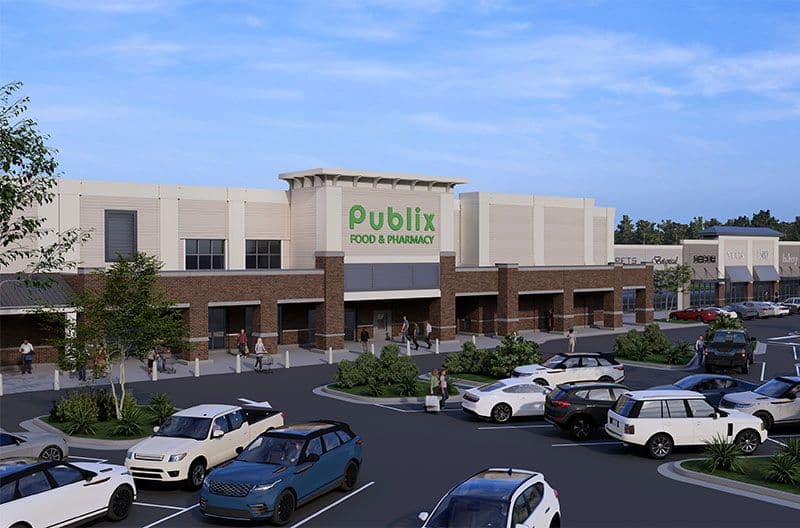
Publix Super Markets has signed a lease for a 50,325-square-foot store at Savannah Branch Town Center in Leland, NC, its fourth location in the Cape Fear region and its first in Brunswick County — the fastest-growing county in North Carolina.
The deal anchors a 131,795-square-foot retail center at U.S. 17 and Lanvale Road, further concentrating national grocery capital along the corridor that has become the region's most contested retail growth lane.
For investors and commercial real estate professionals, this is less about a single lease and more about the accelerating race among national grocers to claim position ahead of a population curve that shows no sign of flattening.
Fast Facts
- Tenant: Publix Super Markets (Lakeland, FL; 1,300+ stores across the Southeast)
- Location: Savannah Branch Town Center (Leland Village), NE corner of U.S. Highway 17 and Lanvale Road, Leland, NC
- Store size: 50,325 sq ft
- Total center GLA: 131,795 sq ft
- Co-tenants: Marshalls, Ulta Beauty, plus 46,970 sq ft of inline retail, dining, and service space
- Available space remaining: 8,750 sq ft
- Estimated jobs: ~140 associates
- Construction timeline: Expected to begin mid-2025; anticipated opening late 2026
- Market area population growth: 9,536 (2020) to 12,760 (2024 projection) — approximately 34% over four years
- Developer: Branch Properties
What Happened
Publix confirmed the signed lease on February 12, 2025, locking the grocer into the anchor position at a development that had been in the pipeline as Leland's retail footprint expands along U.S. 17. Construction on the broader center was expected to begin mid-2025, with an opening targeted for late 2026. No exact opening date for the Publix store has been announced.
The center's tenant roster already includes Marshalls and Ulta Beauty as junior anchors. With only 8,750 sq ft of leasable space still available, the project is approaching full lease-up before the building is complete — a strong demand signal for the corridor.
This will be Publix's fourth Cape Fear location, following stores on South College Road (2016), in Ogden (2017), and at Carolina Beach (2019). Each successive opening has pushed the chain's footprint deeper into suburban and emerging growth areas.
Why It Matters
The Leland lease signals that national grocery operators are now treating Brunswick County as a primary market, not a secondary suburban expansion play. For years, Publix's Cape Fear presence was concentrated in New Hanover County. Crossing the Cape Fear River into Leland — and committing to a 50,000+ sq ft box in a master-planned commercial node — is a strategic bet on durable population growth and rising household density.
This also intensifies the competitive grocery map. Lidl has been expanding its discount format across the Wilmington metro, and Tropicana Supermarkets recently acquired a nearly 45,000-square-foot property at 4510 Oleander Drive in Wilmington for a reported $5.4 million in April 2025, signaling that independent and specialty operators are also bidding for position. The family-owned chain, founded by Felipe Gutierrez, plans to open an international grocery store at the site — its sixth location. Legacy chains like Food Lion and Harris Teeter already have meaningful Brunswick County coverage. The corridor is getting crowded.
What Stands Out
- Near-full lease-up before delivery: Only 8,750 sq ft remains available in a 131,795-sq-ft center still under construction. That's roughly 93% pre-leased — well above typical thresholds for construction-period leasing in secondary Southeastern markets.
- Brunswick County's demographic tailwind is real: The developer projects 34% population growth in the store's trade area between 2020 and 2024 — a trajectory that national site selection teams are underwriting with capital.
- Publix is spacing its bets geographically: The four Cape Fear locations now cover South College Road, Ogden, Carolina Beach, and Leland — a deliberate fan-out that minimizes self-cannibalization while claiming high-traffic nodes before competitors can.
- Anchor-tenant power shapes the corridor: Publix's lease likely enabled the leasing velocity for Marshalls, Ulta, and inline tenants. Grocery-anchored centers consistently outperform non-anchored retail on foot traffic and occupancy in suburban growth corridors.
- The U.S. 17 corridor is evolving from highway retail to town-center format: The Savannah Branch project's mix of grocery, soft goods, beauty, and inline services reflects a shift toward walkable, mixed-use commercial nodes — a higher-value development pattern.
Market Lens: Competitive Positioning
The Cape Fear grocery market is entering a phase of format saturation in growth corridors. Publix, Lidl, Harris Teeter, Food Lion, and now Tropicana are all competing for a consumer base that is growing — but not infinitely. The question for investors and landlords is whether population growth can absorb the square footage being delivered.
Publix's advantage is brand loyalty and a premium positioning that draws higher basket sizes. But its 50,325-sq-ft format carries higher occupancy costs than Lidl's smaller discount boxes, meaning Publix needs a denser, higher-income trade area to perform. Brunswick County's growth trajectory likely supports that model today, but margin compression is a real risk if three or four grocers cluster within a tight radius of U.S. 17 and Lanvale Road.
For Branch Properties, the Publix anchor de-risks the center's remaining inline leasing and provides a foundation for future outparcel development — parcels that could command premium ground lease rates given the traffic a grocery anchor generates.
Risks & Watch-Outs
- Opening timeline is soft: No confirmed date beyond "late 2026" — permitting, labor, or supply chain disruptions could push delivery into 2027.
- Grocery saturation risk: Multiple national and regional chains are targeting the same growth corridor. If household formation slows or competition clusters too tightly, per-store revenue could underperform underwriting.
- Construction cost exposure: A 131,795-sq-ft ground-up retail center in today's materials and labor market carries meaningful cost risk; any budget overruns flow to the developer, but could delay delivery and affect tenant timelines.
- Infrastructure dependency: Leland's U.S. 17 corridor is increasingly congested. Road capacity and intersection improvements will be critical to sustaining the retail traffic volumes these centers require.
- Consumer spending headwinds: Rising interest rates and persistent inflation could pressure discretionary spending. Publix's premium pricing model is more exposed to trade-down behavior than discount competitors like Lidl.
Bottom line for decision-makers: Publix's Leland lease is a confirmed capital commitment from a well-capitalized national operator, and the near-full pre-leasing of Savannah Branch Town Center validates the U.S. 17 corridor as the region's top retail growth lane. But the grocery map is getting dense fast — and the next 12–18 months will determine whether Brunswick County's population curve can absorb the square footage being delivered, or whether early movers start competing for share instead of growth.

Marcus Lane
Marcus Lane writes about real estate, urban planning, and regional business strategy across Southeastern North Carolina. With a background in market analysis and civic reporting, he brings practical insights to emerging development stories and public-private partnerships.
Related Posts
More stories from the same category


Recent Posts
Stay up to date with our latest stories


Subscribe to Newsletter
Provide your email to get email notification when we launch new products or publish new articles