Wilmington's Defense Pitch Draws Summits and Pledges but Zero Confirmed Contracts
Wilmington hosts defense summits and draws a $60M GE Aerospace modernization pledge, but zero confirmed contracts or jobs have materialized from conference activity.

Apr 30 2026
1 min read

Business Summary
New Hanover County captured $130.2 million in federal prime contracts in FY2023, ranking 10th statewide — a respectable but modest position in a state that absorbed $7.38 billion in total federal contract spending.
Despite a Wilmington Defense Summit, a Southeast Region Construction Conference at the Wilmington Convention Center, and a $60 million pledge from GE Aerospace, no publicly confirmed contract awards, job creation numbers, or facility commitments have materialized from any of these events.
The gap between conference rhetoric and binding outcomes is the central concern for investors and developers tracking defense-sector exposure in the Cape Fear region.
Fast Facts
- New Hanover County federal prime contracts (FY2023): $130,181,938
- Statewide federal prime contract total (FY2023): $7.38 billion
- DoD share of NC contracts (FY2023): $4.14 billion
- New Hanover County statewide ranking: 10th
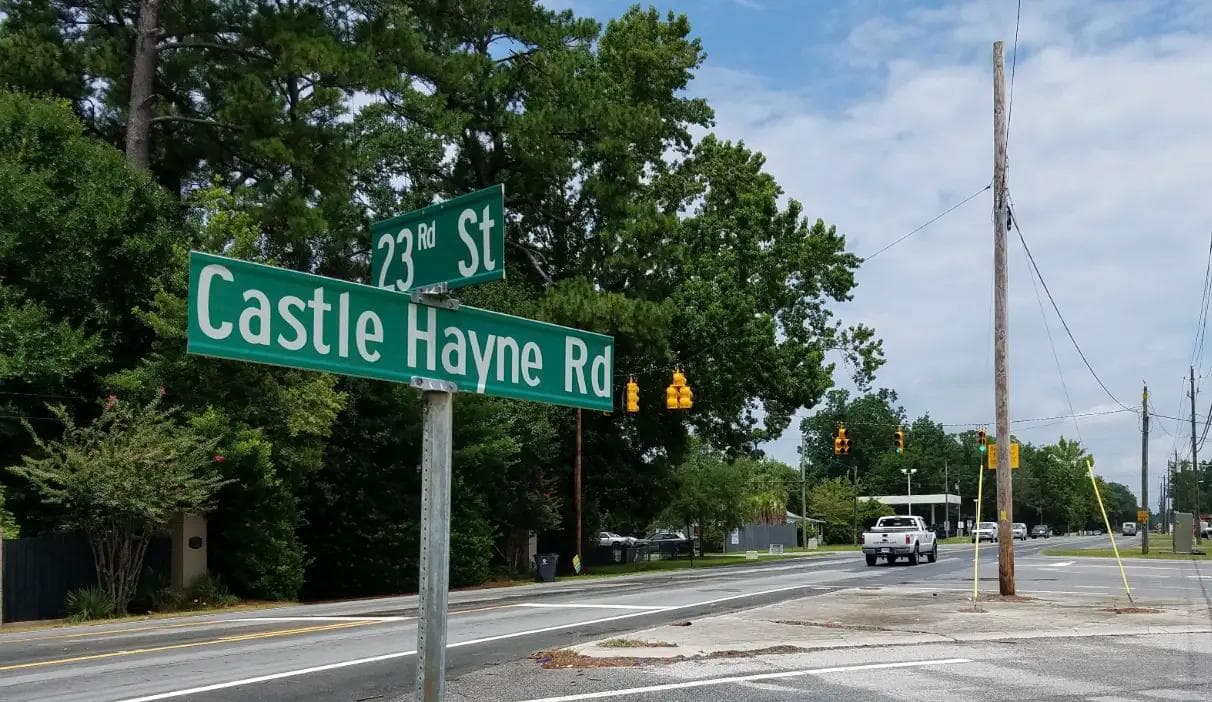
- GE Aerospace local investment pledge: $60 million for equipment modernization and facility upgrades at its Castle Hayne Road site (announced March 2026; no confirmed new job counts, new sq ft, permits, or completion date)
- Confirmed contract awards from Wilmington summits/conferences: Zero
- Proposed FY2027 DoD budget: $1.5 trillion
- Competing NC wins: Pratt & Whitney — 300+ jobs in Asheville; Vulcan Elements — 1,000 jobs in Benson, Johnston County
What Happened
Wilmington has made a visible push to position itself as a defense-industry corridor. The Wilmington Defense Summit courted major DoD spending, and the Southeast Region Construction Conference, held at the Wilmington Convention Center, drew North Carolina builders chasing billions in federal construction contracts. GE Aerospace separately announced a $60 million investment in its Castle Hayne Road manufacturing site in Wilmington, targeting advanced machining equipment, upgraded heat treatment furnaces, and building improvements. The investment supports production of components for narrowbody and widebody aircraft engines, military fighter jets, and naval ships — dual-use aerospace work serving both commercial and military programs. The Wilmington pledge is part of GE Aerospace's $1 billion national initiative to upgrade 30 U.S. facilities and hire 5,000 workers nationwide. In North Carolina specifically, GE Aerospace plans roughly $160 million in spending, including $20 million for Durham tooling and $500,000 for a Fayetteville veteran training program. Over the past three years, GE has invested over $135 million in its Wilmington operations.
However, neither the Defense Summit nor the Construction Conference has produced a single publicly verifiable contract award, facility commitment, or job-creation announcement tied to those events. No specific attending firms, pending RFPs, permit filings, or SEC disclosures have surfaced in public records. The state is broadly pitching defense as a growth sector — leveraging assets like Fort Liberty (formerly Bragg) and Camp Lejeune — but Wilmington's defense narrative beyond the GE Aerospace investment remains aspirational.
Why It Matters
For a market where commercial real estate, industrial site readiness, and workforce pipeline investments are increasingly tied to sector-specific demand signals, the absence of confirmed defense wins from local summits is a material data point. New Hanover County's $130.2 million in federal contracts is meaningful but sits far below peers with embedded military infrastructure: Cumberland County drew nearly $2 billion ($1,975,239,358), Onslow County captured $987.5 million, and Craven County secured $531.3 million.
The $60 million GE Aerospace investment is the most tangible commitment in the pipeline and has been publicly announced with specific scope (equipment modernization and facility upgrades at an existing site). However, without confirmed new job counts, new square footage, or a completion date, the incremental demand impact on industrial space, housing, or workforce programming remains difficult to underwrite precisely. Decision-makers should treat the summit and conference outcomes as unproven, while monitoring GE Aerospace's Wilmington site for permit filings and construction activity.
What Stands Out
- Conference-to-contract conversion is zero. Neither the Defense Summit nor the Construction Conference has produced a publicly documented award. Until RFPs or binding commitments surface, these events are lead-generation exercises, not economic catalysts.
- Wilmington's $130.2 million trails installation-adjacent counties by wide margins. Counties with permanent military bases pull 5x to 15x more federal contract dollars. Wilmington is competing without that structural anchor.
- GE Aerospace's $60 million is scoped but incremental. The announced investment targets equipment modernization and building improvements at GE's existing Castle Hayne Road site — not a greenfield expansion. No new job counts or completion timeline have been publicly confirmed. The economic multiplier depends on whether this generates additional hiring or primarily upgrades existing capacity.
- Competing regions are converting. Pratt & Whitney committed 300+ jobs to Asheville. Vulcan Elements committed 1,000 jobs and up to $1 billion to a rare-earth magnet production facility in Benson, Johnston County, with an average starting salary of $82,000 and construction expected to start within the next year. Anduril — a high-profile defense tech firm — evaluated North Carolina and chose Ohio. Wilmington's pipeline has no comparable announced win from its summit activity.
- The $1.5 trillion proposed FY2027 DoD budget creates a large addressable market, but budget proposals are not appropriations, and appropriations are not contracts. Multiple layers of uncertainty remain.
Market Lens
Angle: Competitive Positioning
Wilmington's defense play is a positioning strategy that is only partially translating into economic commitments. The region lacks the embedded military installation that automatically routes billions in maintenance, logistics, and construction contracts to counties like Cumberland and Onslow. GE Aerospace's existing manufacturing presence — and its $60 million modernization investment — gives Wilmington a real anchor in dual-use aerospace components. But to build a broader defense corridor, the region needs to convert conference activity into prime or sub-prime contract wins that are publicly documented.
The competitive risk is straightforward: other NC metros are landing large-scale commitments while Wilmington hosts conferences. If the GE Aerospace investment drives visible hiring or additional facility expansion, it could strengthen this narrative. Until the summit and conference pipeline produces confirmed awards, Wilmington's broader defense corridor thesis remains a hypothesis, not a data set.
Risks & Watch-Outs
- Execution risk on GE Aerospace: A $60 million modernization investment at an existing facility could be delayed, scaled down, or redirected. Tariff uncertainty on aerospace components adds a layer of supply-chain risk.
- Federal budget volatility: The $1.5 trillion proposed DoD budget faces congressional negotiation. Sequestration-era precedent shows that proposed and enacted figures can diverge significantly.
- Labor competition: Defense manufacturing requires specialized welders, machinists, and cleared personnel. Wilmington's labor market is tight, and competing with Asheville and the Triangle for this talent pool adds cost pressure.
- Site readiness: No Cape Fear-specific RFPs or shovel-ready defense industrial sites have been publicly identified beyond GE Aerospace's existing campus. If a new contract materializes, permitting and entitlement timelines could delay economic impact by 12–24 months (estimated).
- Rhetoric-to-reality gap erodes credibility. Repeated summit announcements without follow-through risk signaling to federal procurement officers — and to private capital — that Wilmington is aspirational rather than operational in this sector.
Takeaway for decision-makers: Do not underwrite broad Wilmington defense-sector growth until at least one publicly confirmed contract, permitted new facility, or binding job commitment materializes from summit and conference activity. The GE Aerospace modernization investment is a confirmed commitment at an existing site — track it for permit filings, hiring announcements, and construction activity. Everything else from the conference pipeline remains unproven.

Marcus Lane
Marcus Lane writes about real estate, urban planning, and regional business strategy across Southeastern North Carolina. With a background in market analysis and civic reporting, he brings practical insights to emerging development stories and public-private partnerships.
Related Posts
More stories from the same category
Recent Posts
Stay up to date with our latest stories


Subscribe to Newsletter
Provide your email to get email notification when we launch new products or publish new articles