New Hanover Bets $6M+ on 300-Acre Holly Shelter Megasite With No Tenant Yet
New Hanover County invests $6M+ to certify a 300-acre Holly Shelter Road megasite with no tenant disclosed, targeting late 2026 shovel-ready status.

Apr 22 2026
1 min read
Investment Summary
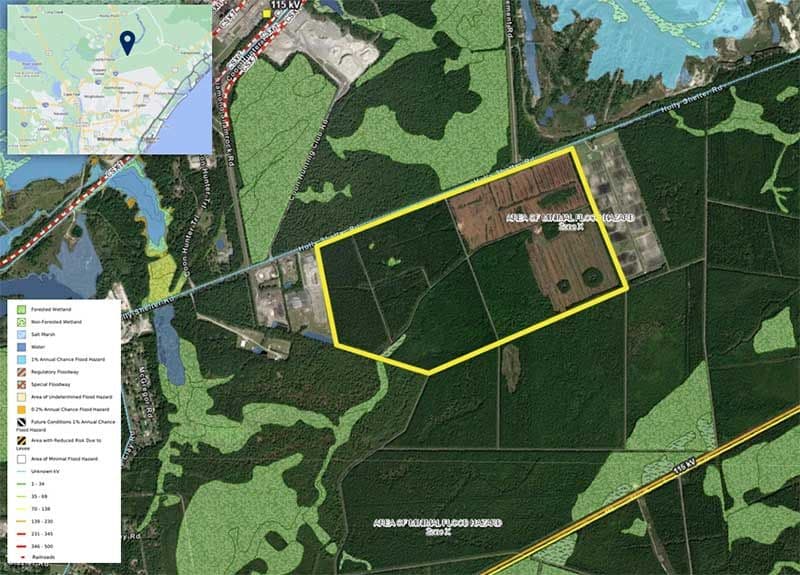
New Hanover County is committing over $6 million in public infrastructure dollars to position a ~300-acre industrial megasite off Holly Shelter Road in Castle Hayne for large-scale manufacturing or distribution recruitment — without a single disclosed tenant, wage commitment, or capital investment projection on the books.
The speculative bet, backed by the state's SelectSites Readiness Program and a Duke Energy infrastructure partnership, aims to make the site shovel-ready by late 2026, cutting prospect decision timelines and enabling the county to compete for projects it currently loses to peer markets with certified inventory.
This is a pure supply-side play: taxpayer capital deployed upfront against the expectation that a certified, infrastructure-ready parcel will attract investment the region cannot capture today.
Fast Facts
- Site: Holly Shelter Business Park | ~300 acres (~253 contiguous, flat, industrial-grade)
- Location: 5800 block Holly Shelter Road, Castle Hayne, NC | ~2 miles from I-40 | near Port of Wilmington
- County investment: $6M+ approved (late 2024) for Phase 1 infrastructure
- Phase 1 scope: 2,750 LF median road, 800 LF turn lane, grading, paving, drainage, utilities
- Bid status: RFB 26-0250, due January 15, 2026 (pre-bid conference December 2, 2025)
- Infrastructure completion target: Late 2026 (water/wastewater, access road extensions)
- State designation: 1 of 15 sites selected from 64 submissions for EDPNC SelectSites program (2023–2024)
- Tenant: None announced | No disclosed investment, jobs, wages, or incentive packages
- Land acquisition: Initial 50 acres purchased early 2023; option on adjacent 200 acres via Cameron Management
What Happened
New Hanover County acquired 50 acres in early 2023 and secured an option on an adjacent 200-acre parcel to assemble a contiguous industrial megasite in the Castle Hayne corridor. In late 2024, county commissioners approved over $6 million for Phase 1 roadway and utility improvements. The site simultaneously earned designation under the state's SelectSites Readiness Program, managed by EDPNC and launched in 2023 specifically for sub-1,000-acre parcels that need infrastructure acceleration.
Duke Energy is collaborating on site readiness, likely through its Site Readiness Program, which funds environmental, geotechnical, and utility assessments that institutional site selectors require before shortlisting a property. Phase 1 construction bids are currently being solicited, with the county targeting late 2026 to bring the site to full shovel-ready marketing status.
Why It Matters
The Wilmington metro has historically lacked certified large-format industrial inventory — the kind of pre-permitted, infrastructure-served parcels that make the first cut when national site selectors screen for large manufacturing or distribution facilities. Without shovel-ready product, prospects requiring fast delivery timelines default to competing markets in the I-85 corridor, Pender County, or South Carolina's Lowcountry.
A 300-acre certified site fundamentally changes the county's positioning. For context, New Hanover's recent industrial pipeline consists of far smaller projects: The Yard Industrial Park at 50,000 sq ft (currently under review) and Standard Technologies Manufacturing (also under review) — neither approaching megasite scale. The only regional comparison is Pender Commerce Park, which has already absorbed logistics demand that might otherwise have landed in New Hanover.
If the megasite attracts a mid-to-large manufacturer, the downstream effects — construction spending, supplier clustering, workforce training investment — could materially shift the county's employment composition away from its heavy tourism and healthcare tilt.
What Stands Out
- No tenant, no projections: The county is spending $6M+ without a disclosed prospect, letter of intent, or target industry vertical. This is speculative infrastructure — high-upside but with no guaranteed return timeline.
- SelectSites scarcity value: Only 15 of 64 submissions earned designation. The credential signals to consultants that zoning, soils, wetlands, and utility capacity have been independently verified — a meaningful friction reduction.
- Port proximity is the differentiator: At ~2 miles from I-40 and near the Port of Wilmington, the site offers intermodal optionality that most competing Southeastern megasites in rural corridors cannot match.
- Castle Hayne is the county's industrial center of gravity: Activity along Blue Clay and Sidbury Roads is clustering, suggesting agglomeration benefits if a major anchor lands at Holly Shelter.
- Cost-per-acre investment is modest: At $6M across ~300 acres, public infrastructure spend runs roughly $20,000 per acre — well below what many jurisdictions spend on megasite preparation, though final costs will rise as water/wastewater extensions proceed.
- No incentive package to evaluate: Without a tenant, there is no incentive-to-investment ratio to analyze. The public subsidy discussion will begin only when a prospect emerges.
Market Lens
Competitive Positioning vs. Peer Markets
New Hanover County is playing catch-up. Markets like Chatham County (anchored by Wolfspeed's silicon carbide facility on the 1,800-acre Chatham-Siler City Advanced Manufacturing Site and VinFast's planned EV plant on a separate ~1,800-acre megasite near Moncure), the Triad megasites, and South Carolina's Lowcountry have spent years building certified industrial inventory that regularly appears on consultant shortlists. Wilmington's economic base — anchored by healthcare, tourism, film production, and a growing tech segment — has never had a shovel-ready parcel large enough to compete for a major advanced manufacturing or distribution campus.
The SelectSites designation and Duke Energy partnership are necessary but not sufficient. To convert interest into commitments, the county will need to layer competitive workforce training pipelines (likely through Cape Fear Community College, which already partners with local manufacturers on production technician and machining programs), demonstrate utility capacity for power-intensive users, and develop an incentive framework that pencils for both the prospect and the taxpayer. The absence of a disclosed water/sewer capacity commitment is a gap site selectors will probe immediately.
If the county executes on its late 2026 timeline, it enters the market during a period of sustained Southeastern industrial expansion — but also during a cycle when interest rates, reshoring momentum, and federal industrial policy (IRA, CHIPS Act spillovers) will determine whether large-format demand remains robust or contracts.
Risks & Watch-Outs
- Demand risk is real: Speculative infrastructure assumes a prospect will materialize. If the site sits vacant for several years, the county's $6M+ outlay generates no return and ties up land that could have been used for other purposes.
- Infrastructure cost escalation: Phase 1 is budgeted, but water/wastewater extensions and any environmental remediation could push total public spend well beyond $6M. No cap has been disclosed.
- Labor market constraints: A large employer requiring hundreds of production workers could stress the local blue-collar labor pool and trigger wage inflation across existing employers. (Specific current unemployment data for the Cape Fear region was not confirmed in public records for this article.)
- Incentive clawback uncertainty: Because no tenant deal exists, there is no clawback structure to evaluate. Policymakers should establish performance benchmarks — minimum jobs, wage floors, capital thresholds — before any prospect-specific incentives are offered.
- Competing sites within the region: Pender Commerce Park and emerging Brunswick County inventory could cannibalize prospects, particularly if those jurisdictions offer faster permitting or lower land costs.
- Macro headwinds: Trade policy uncertainty, potential tariff impacts on manufacturing inputs, and a cooling industrial construction cycle nationally could reduce the universe of active site searches before Holly Shelter reaches market.

Maya Shelton
Maya Shelton joined the Wilmington reporting scene after four years in Big 4 advisory, where she worked with real estate and infrastructure clients across the Southeast. She brings a data-savvy, no-nonsense perspective to emerging business stories, with a focus on economic development and early-stage investment trends.
Related Posts
More stories from the same category
Recent Posts
Stay up to date with our latest stories


Subscribe to Newsletter
Provide your email to get email notification when we launch new products or publish new articles