Historical Deal Analysis: Hotel-to-Apartment Flip on Market Street Nets $6.6M Gain in 3.5 Years
A 230-unit converted hotel on Market Street in Wilmington sold for $17.6M, netting the seller a 60% gain and signaling strong corridor demand.

Apr 17 2026
1 min read
Deal Summary
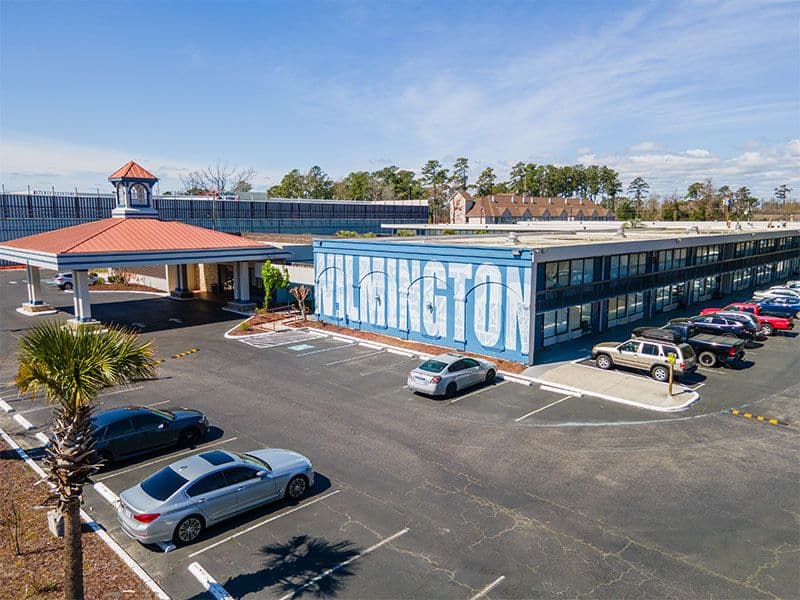
A 230-unit converted hotel at 4903 Market Street in Wilmington traded for $17.6 million on June 18, 2025 — a 60% gain over the seller's $11 million basis from late 2021. The buyer, COW Wilmington LLC, is tied to MPI Family Office out of St. Petersburg, Florida, signaling continued out-of-state institutional interest in Wilmington's workforce housing corridor. The deal prices out to roughly $76,522 per unit and approximately $2.2 million per acre across nearly 8 acres of Market Street frontage.
Fast Facts
- Property: 4903 Market Street, Wilmington, NC
- Sale Price: $17.6 million | June 18, 2025
- Prior Sale: $11 million | Late 2021
- Appreciation: $6.6 million | 60% gain over ~3.5 years
- Units: 230 apartments (converted former Budgetel Inn / Motel 6)
- Acreage: ~8 acres | ~$2.2M/acre
- Price Per Unit: ~$76,522
- Buyer: COW Wilmington LLC (entity formed May 2025; principal office: 2002 Coffee Pot Blvd. NE, St. Petersburg, FL)
- Buyer Principal: MPI Family Office
- Seller: Vivo Living Wilmington LLC (Vivo Investment Group)
- Product Type: Workforce housing / adaptive reuse
- Cap Rate / Rent PSF / NOI: Not publicly disclosed
What Happened
Vivo Investment Group acquired the former hotel property in late 2021 for $11 million and repositioned it as a 230-unit workforce housing complex. The conversion from a dated limited-service hotel — previously operating as Budgetel Inn and Motel 6 — into apartments followed a national trend of adaptive reuse targeting affordability gaps in high-growth Sun Belt metros.
COW Wilmington LLC was formed in May 2025, just weeks before closing — a common structure for single-asset acquisitions by family offices. MPI Family Office lists the property as an acquisition on its website, confirming the capital source behind the entity.
The transaction is part of a broader wave of notable Wilmington CRE deals. NRP Group, a Chicago-headquartered real estate investment firm, recently purchased two retail strip buildings at Independence Mall for nearly $9 million through its entity NRP Independence Strip LLC. The 1.3-acre site includes tenants such as Dave's Hot Chicken, First Watch, and Aye!. Separately, East West Partners acquired land near Wrightsville Beach for $2.7 million for its planned Villa Point townhome project, featuring 18 luxury townhomes in five three-story buildings. Combined, these transactions push recent notable regional CRE volume above $29 million.
Why It Matters
At ~$76,522 per unit, this deal prices well below new-construction multifamily in the Wilmington MSA, where ground-up workforce housing routinely exceeds $150,000–$200,000+ per door in total development cost (estimated industry range; not confirmed by local data). That discount is the core thesis: buy conversion plays at a basis that new supply cannot replicate, then harvest rent growth as the market tightens.
The 60% appreciation in ~3.5 years without a ground-up development cycle illustrates the capital efficiency of hotel-to-apartment conversions in markets where housing demand outpaces supply. Market Street's positioning as Wilmington's primary commercial spine — connecting downtown to the Ogden/Porters Neck growth corridor — adds long-term land value optionality.
The buyer profile matters. A Florida-based family office acquiring workforce housing in Wilmington confirms a capital allocation pattern: private, patient capital moving into secondary Sun Belt markets where yield spreads over gateway cities remain attractive.
What Stands Out
- Basis advantage is the story. At ~$76,500/unit, the buyer enters at a fraction of replacement cost, creating a natural margin of safety even if rent growth moderates.
- Hotel-to-apartment conversions remain viable in Wilmington. The Market Street corridor has aging hospitality inventory that could see further adaptive reuse, particularly as tourism-driven hotels face RevPAR pressure.
- Out-of-state family office capital is accelerating. MPI Family Office's entry mirrors a pattern seen across Wilmington's multifamily and retail sectors — institutional-adjacent capital from Florida and the Northeast targeting the Cape Fear region.
- The ~$2.2M/acre land value on Market Street is a benchmark. For a ~8-acre assemblage on Wilmington's most trafficked commercial corridor, this sets a comp for future land transactions and redevelopment plays.
- Entity formation timing suggests off-market or negotiated deal. COW Wilmington LLC was created just weeks before closing, indicating a targeted acquisition rather than a marketed bid process.
- Vivo's exit at 60% gain validates the conversion thesis without reliance on cap rate compression alone — suggesting NOI growth drove meaningful value creation.
Market Lens
Corridor Strength. Market Street is Wilmington's dominant commercial artery, and this transaction reinforces its dual identity as both a retail/services corridor and a multifamily node. The ~8-acre footprint at the 4903 block sits in a stretch where aging commercial properties are increasingly being evaluated for residential density — a trend accelerated by Wilmington's population growth, military-adjacent demand from Camp Lejeune commuters, and the expansion of UNCW and regional healthcare employment.
With East West Partners assembling land near Wrightsville Beach for the Villa Point project and NRP Group acquiring retail at Independence Mall, capital is stacking along the Market Street–Oleander–Military Cutoff triangle. This corridor convergence suggests institutional players are betting on sustained demographic momentum and constrained new supply in Wilmington's core.
Risks & Watch-Outs
- Deferred maintenance and conversion quality. Former budget hotels converted to apartments can carry elevated capital expenditure risk. Without disclosed renovation scope or property condition data, the buyer's physical due diligence is a critical unknown.
- Workforce housing regulatory exposure. If Wilmington or New Hanover County implements rent control, inclusionary zoning, or conversion restrictions, the operating model could face policy headwinds — though North Carolina's current state-level preemption of rent control limits near-term risk.
- Competing multifamily supply. Wilmington's development pipeline includes several Class A and Class B projects that could pressure occupancy and rent growth at a converted-hotel product, which typically competes at the Class C tier.
- Cap rate and NOI opacity. Without disclosed cap rate, in-place rents, or occupancy data, the market cannot fully benchmark this transaction against institutional multifamily comps in the MSA.
- Insurance and flood risk. A ~8-acre site on Market Street carries standard coastal insurance exposure. Rising premiums across southeastern North Carolina are a structural cost headwind for all multifamily operators in the region.

Daniel Price
Daniel Price brings a decade of experience advising developers and institutional investors on large-scale commercial real estate projects. Now based in Wilmington, he covers local business expansion, leasing trends, and the economics behind downtown redevelopment and land use shifts.
Related Posts
More stories from the same category

Recent Posts
Stay up to date with our latest stories



Subscribe to Newsletter
Provide your email to get email notification when we launch new products or publish new articles