Wilmington Industrial Land Tightens as 250,000 SF Flex Park Breaks Ground
Wilmington's industrial pipeline expands across four corridors as 250,000 SF flex park breaks ground — but US-17 data gaps persist for investors.

Mar 26 2026
1 min read
Business Summary
Industrial land demand in the greater Wilmington market is accelerating, with new Class A flex product breaking ground and multiple corridors — US-421, northern New Hanover County, and the US-17 corridor — competing for distribution and logistics tenants.
The 250,000± sq ft Wilmington Industrial Park on Blue Clay Road, developed by Zephyr Development Co., is the highest-profile addition, but verified data on corridor-specific vacancy compression and lease economics remains thin.
What is clear: the Cape Fear region's industrial pipeline is expanding faster than at any point in recent memory, driven by port activity and e-commerce logistics growth.
Fast Facts
- Wilmington Industrial Park: 23 acres, ~250,000 sq ft across 9 buildings, Class A flex industrial
- Developer: Zephyr Development Co.
- Site work start: Late 2025 | First-phase building delivery: 2026
- Location: Blue Clay Road, with access to I-40 and Wilmington International Airport (ILM)
- Product type: Build-to-suit, divisible lease or purchase configurations
- Competing corridors: US-421 (Wilmington Trade Center), northern New Hanover County, and the US-17 corridor north toward Pender County
- Demand drivers (confirmed): Port of Wilmington throughput growth, e-commerce distribution expansion
- Data gaps: Corridor-level vacancy rates, asking rents per sq ft, specific tenant names, and permit volume are not available from current public sources
What Happened
Zephyr Development Co. broke ground on the Wilmington Industrial Park, a 23-acre Class A flex industrial campus at Blue Clay Road featuring approximately 250,000 sq ft across nine buildings.
Site development commenced in late 2025, with first-phase vertical construction on track for delivery later in 2026. The project is designed with build-to-suit flexibility and divisible space — a configuration that signals the developer is targeting a range of tenant sizes rather than a single anchor user.
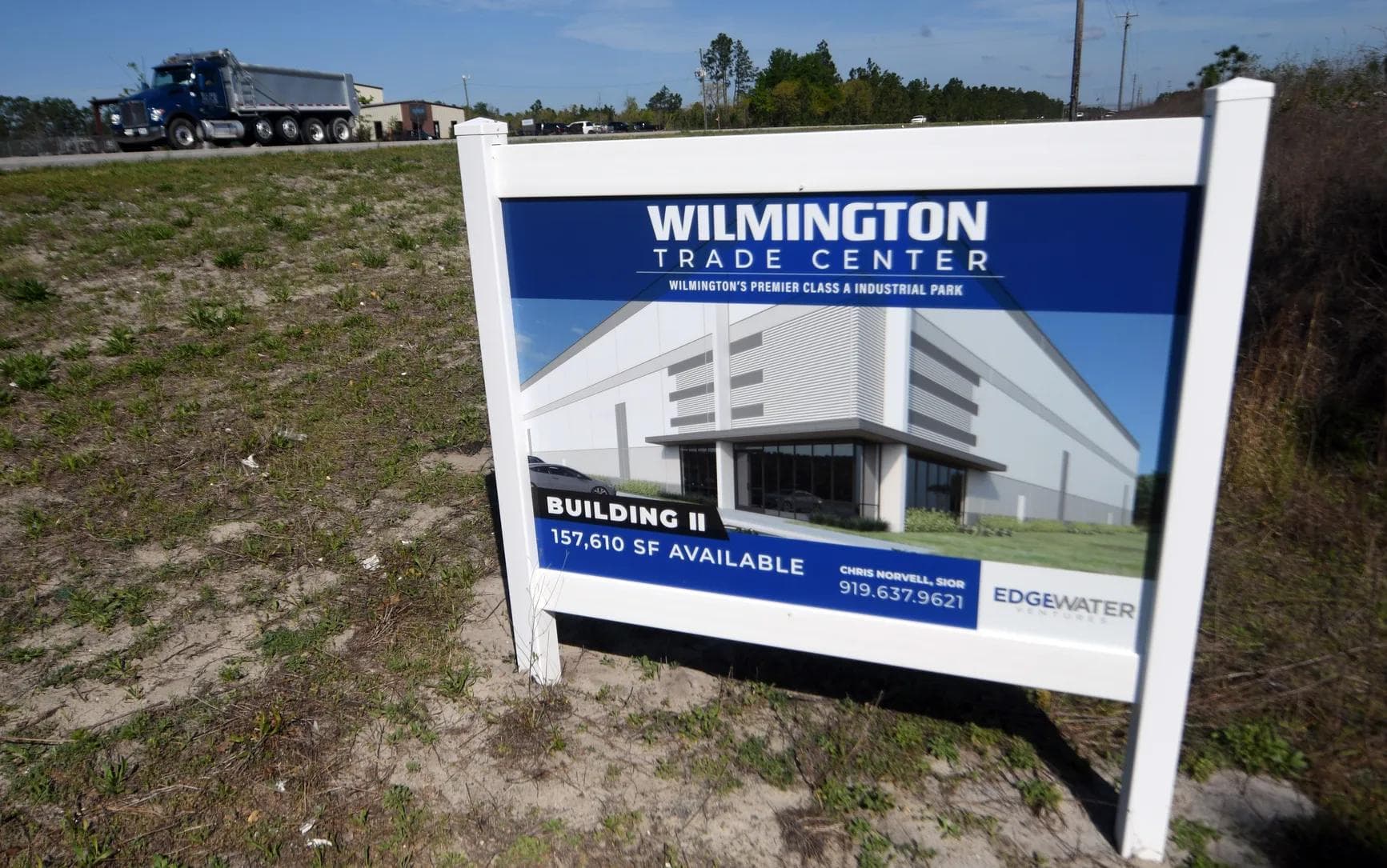
Simultaneously, industrial projects have been rising across northern New Hanover County. The US-421 corridor is seeing expansion anchored by the Wilmington Trade Center, and reporting from WilmingtonBiz confirms that business parks are proliferating in the northern part of the county.
Along the US-17 corridor north of Wilmington — extending into Pender County — anecdotal market signals point to tightening availability, though verified vacancy compression data is not yet available from public sources.
The Port of Wilmington remains a structural demand driver, supporting warehouse and distribution activity as shipping routes expand and e-commerce fulfillment networks decentralize.
Why It Matters
The Cape Fear region is transitioning from a secondary industrial market to an active growth corridor with multiple competing nodes of development. For capital allocators and commercial real estate professionals, the critical question is no longer whether demand exists — it clearly does — but which corridor captures the strongest risk-adjusted returns and which faces execution or infrastructure bottlenecks.
The 250,000 sq ft of new Class A flex product entering the market at Blue Clay Road is significant for two reasons.
First, the build-to-suit and divisible format suggests Zephyr is underwriting to a mid-market tenant profile — likely 10,000–40,000 sq ft users in logistics, light manufacturing, and third-party distribution.
Second, the proximity to I-40 and ILM gives this site a logistics advantage that the US-17 corridor, which depends more heavily on port access and north-south trucking routes, cannot match for air-freight-adjacent tenants.
For the US-17 corridor specifically, the investment thesis rests on proximity to the Port of Wilmington, lower land basis relative to I-40 adjacency, and the anticipated traffic and access improvements tied to the Hampstead Bypass. If vacancy is compressing along US-17 as market participants report, the corridor could see meaningful rent escalation — but that thesis remains unconfirmed by publicly available data.
What Stands Out
- Multi-corridor competition is real. Wilmington's industrial growth is not concentrated in one node. US-421, Blue Clay Road/I-40, northern NHC, and US-17 are all absorbing capital and tenant interest simultaneously. This dispersal could dilute pricing power in any single corridor if supply outpaces absorption.
- Flex product dominance. The Wilmington Industrial Park's nine-building, divisible layout reflects a market bet on smaller, flexible tenants rather than big-box distribution. That's consistent with a mid-market logistics economy, not a major fulfillment hub.
- Port-driven demand is structural, not cyclical. The Port of Wilmington's expanding shipping routes provide a durable demand floor for warehouse and distribution space. E-commerce acceleration reinforces this, but port throughput is the underlying asset.
- The US-17 corridor lacks hard data. Despite strong anecdotal signals, there are no publicly available vacancy rates, asking rents, or lease comps specific to US-17 industrial product. Decision-makers relying on corridor-level underwriting should source CoStar, local broker surveys, or New Hanover/Pender County permit records directly.
- Infrastructure is the swing variable. The Hampstead Bypass and broader transportation improvements along the US-17 corridor will materially affect land values and tenant accessibility. Timing and execution of those projects should be monitored closely.
Market Lens
Corridor Strength. The Wilmington industrial market is no longer a single-corridor story. At least four distinct development nodes are competing for tenants and capital: the I-40/Blue Clay Road area, US-421, northern New Hanover County, and the US-17 corridor extending into Pender County.
This multi-corridor dynamic is a sign of market maturation — but it also introduces competitive pressure. Developers and investors need to underwrite on a site-specific basis, not a regional average.
The corridors with the best logistics access, infrastructure timelines, and entitled land inventory will capture disproportionate demand.
Right now, the I-40/ILM node has the most visible pipeline; the US-17 corridor may have the most upside but carries the most uncertainty.
Risks & Watch-Outs
- Supply overshoot: Multiple projects breaking ground simultaneously across several corridors raises the risk of near-term oversupply if absorption softens or a macro slowdown hits logistics demand.
- Data opacity: The absence of publicly available vacancy, rent, and absorption data for the US-17 corridor makes it difficult to confirm the tightening narrative. Investment decisions should not rely on anecdotal signals alone.
- Infrastructure timing: The Hampstead Bypass and related road improvements are critical to the US-17 corridor's long-term value proposition. Permitting delays or funding shortfalls would directly impair access and tenant demand.
- Labor market tightness: Industrial tenants in the Cape Fear region compete for warehouse and logistics labor in a market with limited slack. Wage pressure could affect tenant economics and lease-up velocity.
- Interest rate environment: Higher-for-longer rates increase development costs and compress yields, particularly for speculative flex product without pre-leasing commitments.

Jordan Reese
Jordan Reese covers commercial real estate and business trends across Wilmington and the greater Cape Fear region. With a focus on investment activity and regional growth, Jordan provides clear, research-informed reporting for business owners, investors, and civic stakeholders.
Related Posts
More stories from the same category


Recent Posts
Stay up to date with our latest stories



Subscribe to Newsletter
Provide your email to get email notification when we launch new products or publish new articles