Amazon's 1,000+ Job Fulfillment Center Tests Wilmington's 3.4% Labor Market
Amazon's 650K-SF robotics fulfillment center targets 1,000+ jobs at $22+/hr in Wilmington — testing a 3.4% unemployment labor market with zero disclosed incentives.

Mar 28 2026
1 min read
Investment Summary
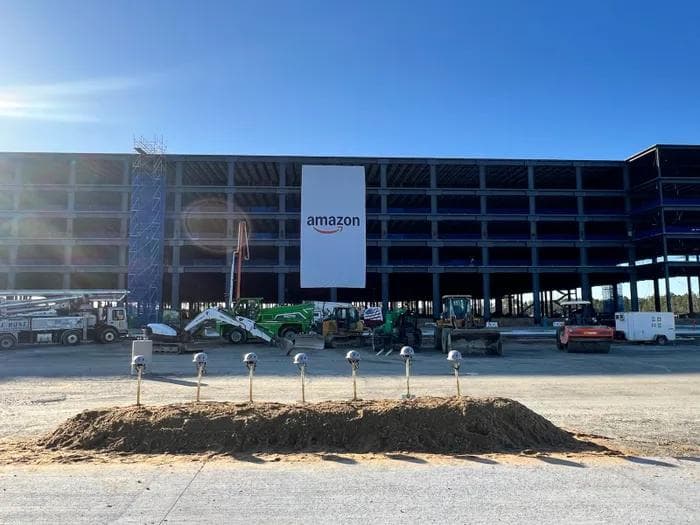
Amazon is standing up the largest fulfillment center in North Carolina along the New Hanover-Pender County line, a 650,000-square-foot robotics facility projecting 1,000+ direct jobs and an estimated 445 indirect positions. At a base wage floor exceeding $22/hour in a metro where unemployment sits at just 3.4%, this is as much a labor-market stress test as it is a logistics expansion. The project, announced March 12, 2026, slots into Amazon's $12 billion, 27,000-job North Carolina footprint — but it arrives without any disclosed public incentive package, which itself is a notable data point.
Fast Facts
- Company: Amazon (e-commerce, logistics, robotics fulfillment)
- Facility: 650,000 sq ft building footprint | 3M+ sq ft across 4.5 floors
- Location: Greater Wilmington, NC — New Hanover-Pender County line, near Pender Commerce Park
- Direct jobs: 1,000+ full- and part-time
- Indirect jobs: ~445 (estimated)
- Base wage: >$22/hr avg | >$29/hr total compensation with benefits
- Total investment: Not publicly disclosed (Amazon's NC-wide total: $12B since 2010)
- Public incentives: None reported
- Timeline: Groundbreaking fall 2025 | Announced March 12, 2026 | Opening targeted Q3 2026 / holiday season 2026
What Happened
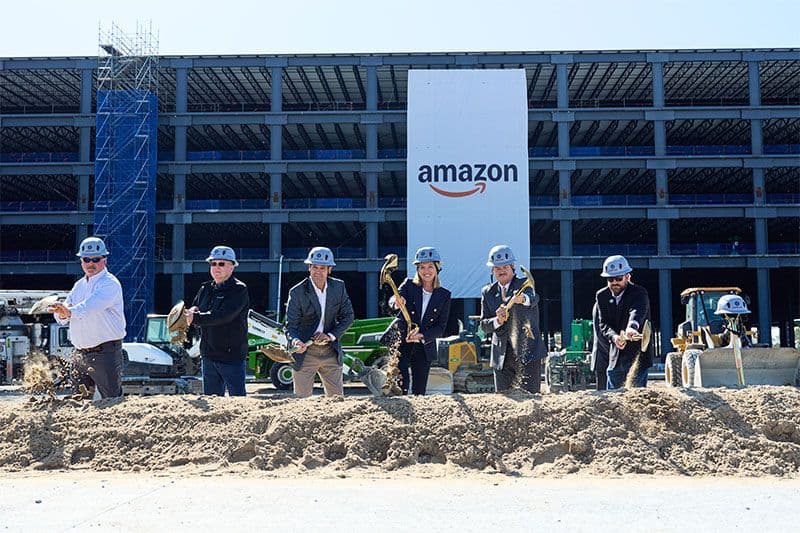
Amazon confirmed on March 12, 2026 that it will open its first robotics fulfillment center in the Greater Wilmington market, a multi-story facility near Pender Commerce Park that breaks from the company's traditional single-story warehouse model. Construction broke ground in fall 2025, and the company is targeting an operational launch ahead of the 2026 holiday peak season.
The project is paired with a planned last-mile delivery station at the northern edge of Pender Commerce Park, signaling Amazon's intent to build a vertically integrated logistics node — from robotic sortation to final-mile delivery — in the region.
Why It Matters
The headline job count of 1,400+ positions (direct plus indirect) would represent one of the single largest employment injections in the Wilmington metro in recent years. At >$22/hour base, these roles sit meaningfully above the national median warehouse wage of roughly $18/hour and above the Wilmington metro's median hourly earnings for transportation and warehousing occupations.
Annualized, 1,000 direct jobs at $22/hour equate to approximately $45.8 million in annual base payroll flowing into the local economy. When total compensation of >$29/hour is factored in, the gross labor spend approaches $60 million annually — a significant recurring demand signal for housing, retail, and services.
The 3M+ square feet of operational floor space compressed into a 650,000-square-foot footprint via multi-story construction also resets expectations for industrial density in a market historically characterized by single-story distribution facilities.
What Stands Out
- No disclosed incentives. Unlike many deals of this scale, no state grants, tax abatements, or local incentive commitments have surfaced. If confirmed, this means the public cost-per-job is effectively $0 — an extraordinary incentive ROI by any benchmark.
- Wage premium matters. At >$22/hour, Amazon's base floor is roughly 22% above the national median warehouse wage of approximately $18/hour, which could exert upward pressure on competing logistics and manufacturing employers in the Wilmington area.
- Multi-story robotics format. The 4.5-floor, 3M+ sq ft layout is Amazon's advanced fulfillment template — capital-intensive, automation-heavy, and designed to reduce per-unit labor dependency over time. Job counts should be watched for long-term sustainability.
- Labor absorption risk is real. Adding 1,000+ positions into a metro with 3.4% unemployment means Amazon will almost certainly pull workers from existing employers or require net in-migration. Either outcome has downstream effects.
- Housing math is tight. At $22/hour (~$45,760/year), a single-earner household faces a price-to-income ratio of roughly 9.5x against the metro's $433,000 median home price — well beyond the conventional affordability threshold of 3-4x.
- Paired delivery station amplifies impact. The adjacent last-mile facility at Pender Commerce Park suggests Amazon is building a full logistics corridor, not a standalone warehouse.
Market Lens: Workforce Absorption
This is the critical analytical frame. Wilmington's 3.4% unemployment rate is effectively at or near full employment. Amazon needs to fill 1,000+ roles by Q3 2026 — a roughly six-month hiring window from announcement to operations.
The company's $22+/hour wage floor gives it a competitive advantage in recruiting, but every worker Amazon attracts is one less available to regional employers in healthcare, hospitality, construction, and existing logistics operations. For a metro of Wilmington's size (~480,000 MSA population as of 2024), absorbing a single employer's thousand-plus headcount without friction is uncommon.
Two scenarios emerge. In the first, Amazon's wage premium triggers meaningful in-migration, which partially resolves the labor constraint but intensifies housing demand in an already strained market. In the second, Amazon pulls from the existing labor pool, forcing competitors to raise wages — beneficial for workers, costly for employers already operating on thin margins in sectors like food service and retail.
Workforce planners should monitor Cape Fear Community College and regional training pipelines for capacity to support robotics-adjacent skills. Amazon's advanced fulfillment centers typically require a mix of entry-level material handlers and higher-skilled maintenance and robotics technicians — the latter being a talent pool that is scarce nationally, not just locally.
Risks & Watch-Outs
- Job projections vs. verified headcount. The 1,000+ direct / ~445 indirect figures are Amazon's announced projections. Indirect job estimates in particular rely on economic multiplier models that vary widely. These numbers should be treated as unverified until post-opening employment data is available.
- Automation trajectory. Amazon's robotics fulfillment centers are designed to increase automation density over successive operational years. The Year 1 headcount may not reflect Year 5 staffing — a critical distinction for workforce planners relying on sustained employment.
- No incentive clawback leverage. If no public incentives were granted, the region has no contractual mechanism to enforce job-count or wage commitments. Amazon can scale staffing to operational need without penalty.
- Housing affordability pressure. Net in-migration driven by this facility and the adjacent delivery station could accelerate price appreciation in an already elevated market, potentially undermining the region's cost-of-living advantage relative to peer metros like Raleigh-Durham and Charleston.
- Macro sensitivity. Fulfillment center throughput is directly tied to consumer spending. A meaningful slowdown in e-commerce demand could delay full ramp-up or reduce seasonal surge hiring, compressing the actual economic impact below projections.

Maya Shelton
Maya Shelton joined the Wilmington reporting scene after four years in Big 4 advisory, where she worked with real estate and infrastructure clients across the Southeast. She brings a data-savvy, no-nonsense perspective to emerging business stories, with a focus on economic development and early-stage investment trends.
Related Posts
More stories from the same category


Recent Posts
Stay up to date with our latest stories




Subscribe to Newsletter
Provide your email to get email notification when we launch new products or publish new articles