Wilson Center's Grammy-Caliber Bookings Signal Maturing Venue Strategy
Wilson Center's March lineup including Grammy winner Samara Joy, signals growing programming depth at Wilmington's $36.5M performing arts venue.

Mar 30 2026
1 min read
Business Summary
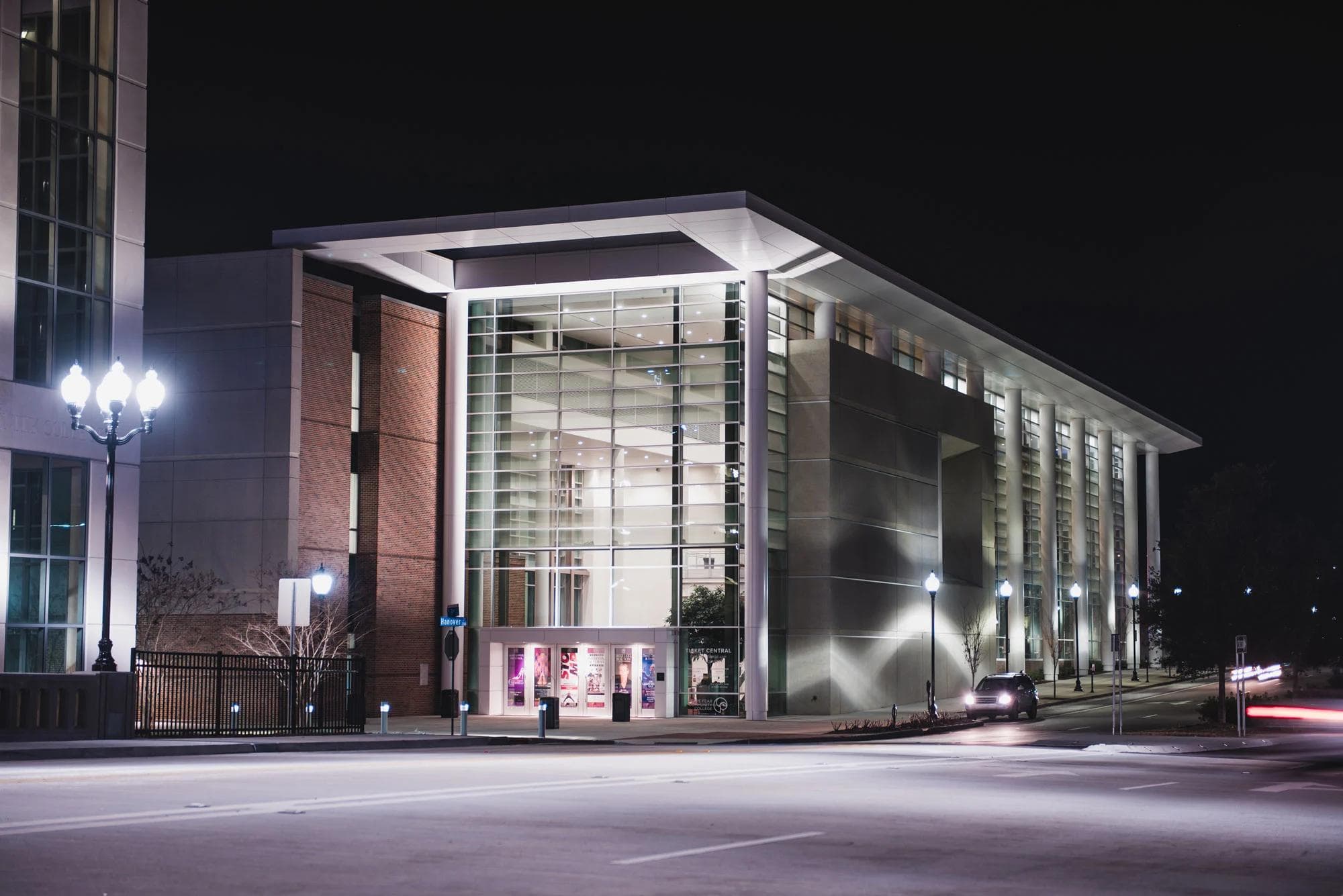
CFCC's Wilson Center — the Cape Fear region's largest performing arts venue at 150,000 square feet and 1,499 seats — hosts Grammy-winning jazz vocalist Samara Joy on Saturday, March 28, capping a month of nationally touring acts that includes KC and the Sunshine Band, the North Carolina Symphony, and The Infamous Stringdusters.
The booking density matters because it suggests the $36.5 million publicly funded facility is beginning to operate at a programming cadence that can generate meaningful downstream economic activity for downtown Wilmington's hospitality and retail corridor.
Fast Facts
- Venue: Wilson Center, 703 N 3rd St., Wilmington, NC 28401
- Operator: Cape Fear Community College (CFCC)
- Facility size: 150,000 sq ft total; performance hall at 1,499 seats; main stage 41 ft deep × 87 ft wide
- Construction cost: $36.5 million
- 2021 expansion donation: $500,000 for special event space and donor lounge
- Event spaces: ~10,000 sq ft of rentable area; reception capacity 2,000; banquet capacity 600
- Parking: Adjacent Hanover Student Parking Deck, $10/vehicle (card only); VIP/donor parking at $500+ Annual Fund level
- Artist: Samara Joy, Grammy Best New Artist winner (2023)
- March bookings also include: KC and the Sunshine Band, NC Symphony Beethoven 'Emperor' Piano Concerto, The Infamous Stringdusters (Greenfield Lake Amphitheater)
What Happened
Samara Joy, one of jazz's most commercially viable young touring artists after her 2023 Grammy for Best New Artist, performs a headlining concert at the Wilson Center this Saturday. Joy's national touring profile places this booking in a tier above typical regional programming.
The concert arrives at the end of a March lineup that featured at least four notable national or institutional acts across Wilmington venues. That clustering is unusual for a mid-size Southeast market and reflects deliberate programming ambition by the Wilson Center's booking operation.
The Wilson Center itself is a dual-use facility: it functions as CFCC's Humanities and Fine Arts Center during the academic calendar, with classrooms, faculty offices, and instructional space, while operating as a professional touring venue with backstage infrastructure including two-star dressing rooms, three group dressing rooms, a green room, wardrobe room, and a two-bay loading dock capable of handling large production loads.
Why It Matters
The economic logic of a $36.5 million public performing arts investment hinges on two things: programming quality high enough to draw regional audiences and booking frequency sufficient to generate consistent foot traffic for the surrounding commercial district.
A single marquee booking proves little. But four nationally recognized acts in a single month — spanning jazz, classic rock, orchestral, and bluegrass — suggests the venue is approaching a programming mix designed to pull from multiple audience demographics. That variety matters for downtown Wilmington businesses that depend on pre-show dining, post-show drinks, and overnight stays from out-of-market attendees.
The $500,000 private donation in 2021 for event space expansion signals that donor confidence in the venue's trajectory was already building several years ago. The current booking cadence appears to validate that bet.
What Stands Out
- Genre diversification is a demand signal. Jazz (Samara Joy), classic rock (KC and the Sunshine Band), orchestral (NC Symphony), and bluegrass (Infamous Stringdusters) in a single month suggests the Wilson Center is actively testing which audience segments drive the strongest ticket revenue in this market.
- The facility is overbuilt for a community college — by design. A 41 × 87-foot main stage, professional rigging, and a two-bay loading dock are touring-grade specs. This infrastructure positions the Wilson Center to compete for routing stops that might otherwise bypass Wilmington entirely.
- Parking revenue is a quiet margin line. At $10/vehicle across a 1,499-seat house, a sold-out show could generate meaningful parking revenue from the adjacent deck — though the exact figure depends on per-vehicle occupancy rates and the share of attendees using the deck, which are not publicly available.
- Downtown adjacency amplifies the multiplier. The 703 N 3rd Street location places the venue within walking distance of Wilmington's core restaurant and hotel inventory, maximizing per-event economic spillover.
- No public ticket revenue data is available, which limits any rigorous analysis of the venue's financial self-sufficiency or per-event contribution margin.
Market Lens
Angle: Tourism / Visitor Economy
Wilmington's visitor economy has historically leaned on film production, beaches, and historic district foot traffic. The Wilson Center's maturation as a touring-act destination introduces a performing arts vertical that most mid-size Southeast coastal markets lack at this scale.
The competitive benchmark is instructive. Within the region, Greenfield Lake Amphitheater handles outdoor bookings (it hosted the Stringdusters this month), but it lacks climate-controlled, year-round capability. The Wilson Center's enclosed 1,499-seat hall gives Wilmington a four-season venue that can attract acts during shoulder and off-peak tourism months — precisely when the hospitality sector needs demand the most.
For hotel operators, restaurant groups, and downtown retail investors, the question is whether the Wilson Center's programming trajectory can sustain a high number of high-draw events per year — the rough threshold at which a venue begins to meaningfully influence surrounding property demand and lease rates. The March evidence is encouraging, but one strong month does not confirm an annual pattern.
Risks & Watch-Outs
- Revenue opacity. No public ticket sales data, per-event financials, or occupancy rates are available for the Wilson Center. Without that transparency, it is impossible to assess whether the venue is operating at a sustainable margin or relying on CFCC subsidy.
- Public funding dependency. As a community college asset, the Wilson Center's capital budget is ultimately tied to state and county education funding cycles, which introduces political risk to long-term maintenance and reinvestment.
- Competition for touring acts is intensifying. Other mid-size venue developments across the Southeast are competing for the same routing slots. Wilmington must continue upgrading its value proposition to agents and promoters.
- Parking friction. A card-only, $10/vehicle model at the adjacent deck could suppress impulse attendance, particularly for price-sensitive demographics. Cash-free systems also create a data trail that could be leveraged for audience analytics — but only if the operator invests in that capability.
- No reported job creation data. The downstream employment impact of venue operations — box office, security, catering, technical crew — is not publicly quantified, leaving a gap in any workforce analysis.
Bottom line for decision-makers: The Wilson Center's March booking slate is strong public evidence that Wilmington's $36.5 million performing arts investment is generating the kind of programming gravity that supports adjacent commercial value. Investors and operators in the downtown corridor should be tracking annual event counts and genre mix as leading indicators of sustained visitor economy growth — not just individual headline acts.

Maya Shelton
Maya Shelton joined the Wilmington reporting scene after four years in Big 4 advisory, where she worked with real estate and infrastructure clients across the Southeast. She brings a data-savvy, no-nonsense perspective to emerging business stories, with a focus on economic development and early-stage investment trends.
Related Posts
More stories from the same category




Recent Posts
Stay up to date with our latest stories


Subscribe to Newsletter
Provide your email to get email notification when we launch new products or publish new articles